
Commercial Slicers, Dicers and Cutters Buying Guide
Cutting produce to a consistent size by hand takes time, skill and labour, and the results change from cook to cook. A commercial slicer, dicer or cutter takes over the repetitive part: one stroke gives uniform dice, slices, wedges or fries, with less waste and more even cooking. The right choice depends on three things: what you cut, which cut you need, and how much you cut.
The short version. Cubes: a dicer or push-through cutter with a dice blade. Tomatoes and onions: a dedicated slicer. Fries and potato sticks: a fry cutter. Wedges: a wedger. Occasional slicing, julienne and garnish: a mandoline or spiral slicer. Sustained volume: an electric vegetable slicer. Then match the blade size to your recipes and the mounting to your space.
Quick Picker: find the right slicer, dicer or cutter
Tell the picker what you are cutting, then the cut size or style you need. It narrows the range to the right type and shows one current Russell Hendrix model that fits, with the reasons. It follows the same steps this guide explains: the cut, manual or electric, the type, the size, then your kitchen's constraints.
The picker is a starting point, not a full equipment assessment. It reads each product's listed specifications from our live range and only recommends products that can be ordered today. Confirm details on the product page before you buy.
1. Start with the cut, not the tool
Most buying mistakes come from choosing a tool before describing the cut. Write down the shape and size you need most often, because that decides the type of machine.
| What you need | Best-fit tool | Notes |
|---|---|---|
| Uniform cubes of onion, pepper, potato or fruit | Manual dicer or push-through cutter | Choose the blade size your recipes call for. |
| Even slices of tomato, onion or other soft produce | Dedicated manual slicer | Razor-sharp blade sets are designed to cut without squashing. |
| Slices of varying thickness, julienne, chips | Adjustable slicer or mandoline | Best for small to moderate volume. |
| French fries, steak fries, potato sticks | Push-through fry cutter | Built for the force needed to cut potatoes. |
| Wedges of tomato, citrus, apple | Wedger | Fixed number of sections per push. |
| Spiral strands for garnish and salads | Spiral slicer | Continuous spiral cuts. |
| Large amounts of sliced or grated produce, all service | Electric vegetable slicer | See section 2. |
| Dicing plus sauces, purees and chopping | Food processor | See our commercial food processor buying guide. |
2. Manual or electric?
This is the biggest fork in the decision. Manual cutters are powered by your hand, so they need no electricity, take up little space and can be moved to where the work is. Electric slicers do the work with a motor and discs, which matters when the cutting never stops.
| Consider | Manual | Electric |
|---|---|---|
| Volume | Steady prep, with the operator supplying the effort. | Sustained, high-volume slicing and grating. |
| Cuts | One cut per blade set, often swappable. Dice, wedge and fry blades are common. | Slicing, grating and shredding with discs; some models also chop and blend. |
| Space and power | Small footprint, countertop or wall-mounted, no outlet needed. | Needs an outlet, and some models need a higher-voltage supply. |
| Cleaning | Fewer parts, quick to rinse and store. | More parts to clean, including discs. |
| Labour | Operator effort on every stroke. | Less effort, faster feeding. |
If you also need sauces, purees or dough work, an electric combined slicer and cutter mixer covers both jobs, and a continuous feed food processor with a dicing kit is another route. Compare them in our food processor guide and our comparison of blenders, food processors, mixers and grinders.
3. The types, and who each is for
All-purpose manual cutters
The most common design is a sturdy metal frame with a push block that is guided down onto a blade assembly. A container placed under the blades catches the cut product. Blade assemblies change in moments, so one frame can dice, wedge or slice depending on the blade fitted. Very hard vegetables in large quantities, such as sweet potatoes, can stretch lighter models.

Dedicated slicers: tomato, onion and fruit
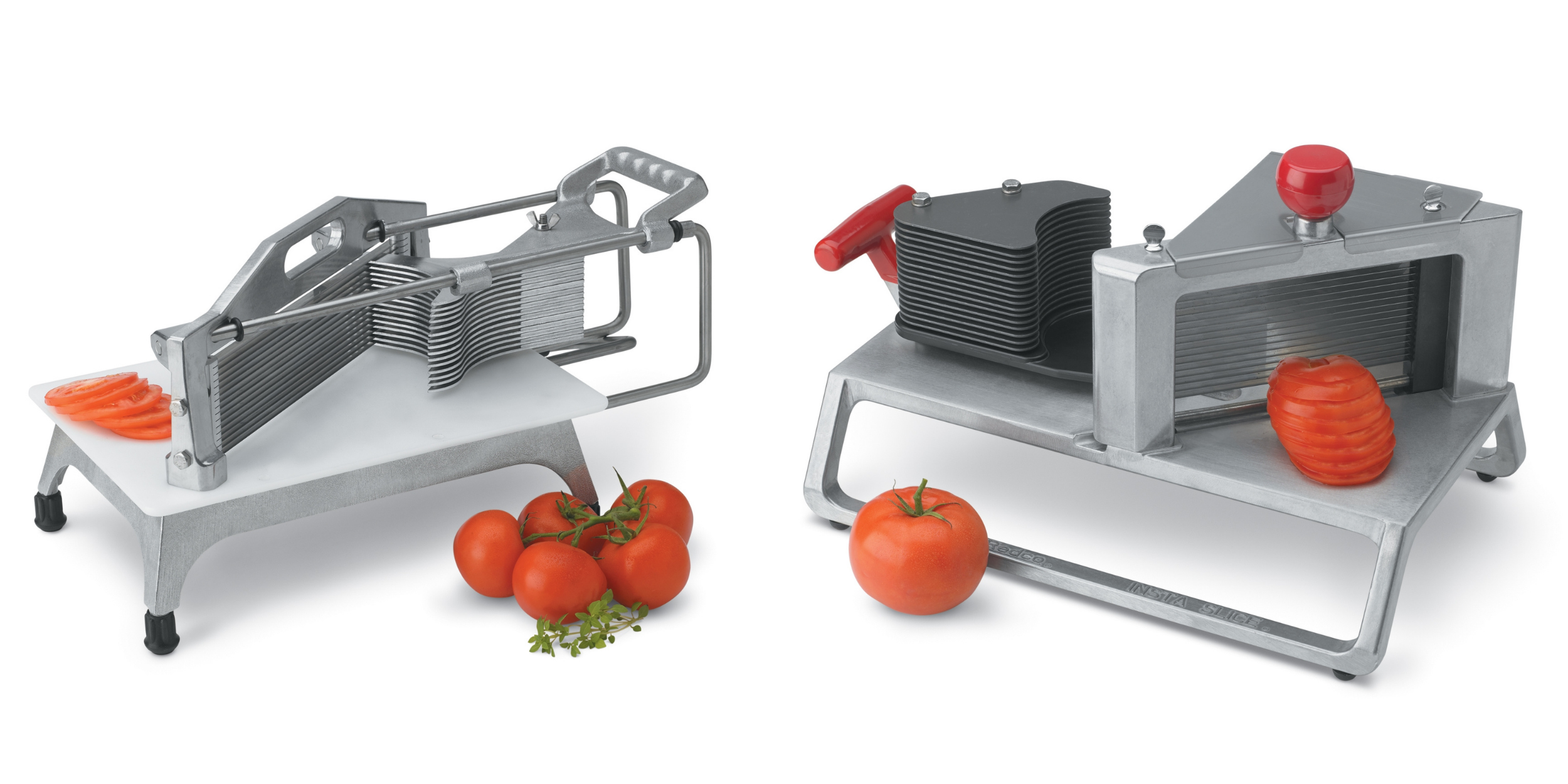
Ripe tomatoes are hard to slice without squashing them, so tomato slicers use razor-sharp blade sets built for the job and cut a whole tomato in one stroke. Onion and fruit slicers work the same way with blade spacing set for the slice thickness. Adjustable slicers let you change the thickness with a screw.
Dicers and chopper grids
Push-through dicers force produce through a grid of blades to produce cubes in one stroke, and grid choppers cut produce into cubes the same way. Some manual dicers only cut short strips, so produce may need to be pre-sliced first; check how the model is intended to be used.
French fry cutters
Cutting a lot of potatoes tests even the best all-purpose cutter, and blades can dull or bend over time. A push-through fry cutter is built for the load, cutting fries or potato sticks in one stroke of a lever.

Wedgers
Wedgers cut tomatoes, citrus, apples and similar fruit into a fixed number of sections with one push. They are common in bars, pubs and salad stations.
Mandolines and spiral slicers
Mandolines are inexpensive, compact and stored in a drawer. They slice, julienne and make chips and waffle cuts. Hand-held models have a handle you grip while pushing the produce across the blade; stand models are larger and more stable. Blades can be straight, diagonal or V-shaped, and some are adjustable or interchangeable. Frames are plastic or stainless steel, so make sure any model has a good guard. A spiral slicer produces continuous spiral strands for garnish, baskets and salads.

Electric vegetable slicers
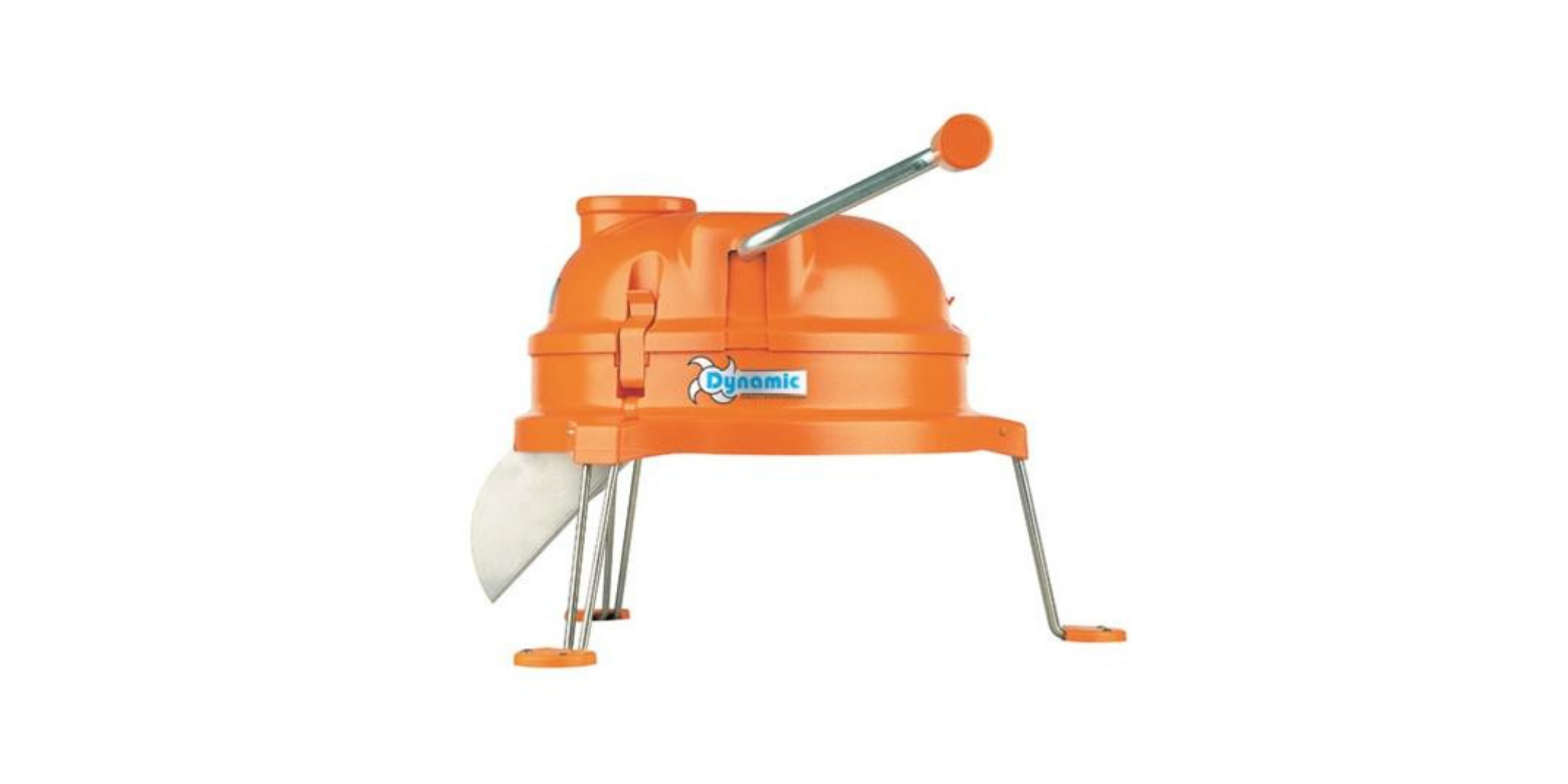
An electric slicer feeds produce through a hopper to a rotating disc, so it slices, grates and shreds quickly. Some are single-purpose slicers; others combine a slicer with a cutter mixer bowl so the same machine can also chop, mix and emulsify.
4. Cut sizes and blades
The blade decides the cut, so check that the size you need is offered before anything else. As a guide, the manual cutters in our range come in the following sizes.
| Cut | Sizes commonly offered | Typical use |
|---|---|---|
| Dice | 1/4", 3/8", 1/2" | The smaller the dice, the finer the finished texture. Smaller for salsa and sauces, larger for soups and stews. |
| Slice | 3/16", 1/4", 3/8", 1/2" and adjustable | Thin for sandwiches, thicker for burgers and grilling. |
| French fry | 9/32", 3/8", 7/16" | Thinner for shoestring fries, thicker for steak fries. |
| Wedge | Commonly 8 sections | Tomato, citrus and apple garnish. |
Sizes vary by model, so confirm the exact blade on the product page.
Interchangeable blades
Many manual cutters let you swap the blade assembly in moments, so you can go from dicing to wedging between jobs. Blades should be strong enough to cut repeatedly without dulling, but it is sensible to buy a spare set. Before you buy, check that replacement blades and other blade types are available for the model.

5. Check it against your kitchen
Counter or wall-mounted
Short of counter space? A wall-mounted cutter needs only a couple of feet of free wall, and processed product can fall straight into a container of any size placed below. Countertop models can be stored away when not in use.

Stability
A countertop cutter must stay put on a wet stainless steel work surface. Look for skid-resistant feet or suction cups. Some models can be bolted down, which solves stability but means they cannot be put away.
Material and build
Commercial manual cutters are generally sturdily built, and all-purpose models often have aluminum or stainless steel frames. Hand-held mandolines are often plastic apart from the blade, which keeps them light, though an all stainless steel model may suit a hard-working kitchen better.
Safety and cleaning
Choose tools with protective guards, and keep fingers off the blades. Look for models that rinse clean easily and have few parts that trap food. Replace blades that dull or bend, since a dull blade needs more force.
Electric power
For electric slicers, confirm the voltage against your supply. Most compact models run on 120V; the highest-capacity models may need 208-240V. Have your electrician check before you order anything above 120V.
Before you buy: a quick checklist
- I know the cut and size I need most often.
- I have decided between manual and electric based on volume.
- The blade size I need is offered, and spare blades are available.
- It suits my produce: tomatoes, onions, potatoes or firm vegetables.
- It fits my counter or wall, and it will stay stable in use.
- For an electric model, the voltage matches my kitchen's supply.
- I have checked the product page for the full specification.
Keep exploring
- Commercial food processor buying guide
- Blenders, food processors, mixers and grinders compared
- Shop vegetable cutters, dicers and fry cutters
- Shop manual slicers, dicers and cutters
- Shop mandolines
- All buying guides
Not sure which model fits your kitchen?
Tell our team what you cut and how much, and we will help you confirm the type, size and mounting. Contact Russell Hendrix Sales.
Frequently asked questions
What is the difference between a slicer, a dicer and a cutter?
A slicer cuts flat slices, a dicer cuts cubes, and "cutter" is the general term for tools that cut produce into a set shape such as fries or wedges. Many manual cutters fit different blade assemblies, so one frame can do more than one cut.
Should I choose a manual or an electric slicer?
Manual cutters need no electricity and suit steady prep in small spaces. An electric slicer is the better choice if slicing and grating run for most of the service, because the motor does the work. If you also need to chop and blend, consider an electric slicer combined with a cutter mixer, or a food processor.
What dice size do I need?
Match the dice to the dish. Smaller dice such as 1/4" suit salsa and sauces, 3/8" suits salads and soups, and 1/2" suits stews and roasting. Check that the blade size you want is offered.
Can a manual dicer cut hard vegetables and potatoes?
Yes, within limits. Firm produce works well, but cutting large quantities of very hard vegetables such as sweet potatoes can stretch lighter models. For fries, use a fry cutter built for the load.
How do I slice tomatoes without squashing them?
Use a tomato slicer. Its blade set is razor-sharp and designed to cut a ripe tomato in one stroke. Keep it for tomatoes and similar soft produce so the blades stay keen.
Should I choose a countertop or a wall-mounted cutter?
Choose wall-mounted if counter space is tight, because it needs only a short stretch of wall and drops product into a container below. Choose countertop if you want to store the cutter away when it is not in use, and make sure it has skid-resistant feet.
Are replacement blades available?
For most manual cutters, yes, but it varies by model. Check availability before you buy, and consider a spare set so you can swap blades when they dull.
Can a food processor do the same job?
A continuous feed food processor with the right discs and a dicing kit can slice, shred and dice at volume, and a batch bowl model also handles sauces and purees. See our food processor guide to compare.
