
Cooking and Kitchen Thermometers Buying Guide
Commercial Kitchen Thermometers Buying Guide
Professional kitchens cannot (and should not) operate without thermometers. Thermometers are the only way to accurately measure temperatures for food safety, but they’re also key for prep, quality control, and monitoring fridges, freezers, and dishwashers.
Because no single thermometer does everything, most operations benefit from a selection of kitchen and cooking thermometers to cover different tasks.
Last updated: January 29, 2026
Types of Cooking and Kitchen Thermometers
There are two main categories of thermometers: mechanical and electronic.
Mechanical thermometers use liquids or metals that expand/contract to measure temperature. Electronic thermometers use electrical resistance, electricity generation, or electromagnetic radiation to measure temperature.
You don’t need to know the science—just match the type to the job for speed, accuracy, and workflow.
Liquid Thermometers (Tube Thermometers)
Liquid thermometers use a food-safe coloured liquid inside a glass tube (usually protected by a case). As temperature changes, the liquid expands or contracts. They’re simple, no-tech, and affordable—but slower and harder to read from a distance.
Because they’re typically waterproof and steam-proof, they’re common for candy making, deep frying, and chocolate tempering—plus fridge/freezer monitoring.
Popular uses
- Refrigerators
- Freezers
- Candy
- Deep fryers
- Chocolate tempering

Dial Thermometers (Bimetal / Bimetallic)
Dial thermometers have a circular scale with a pointer that indicates temperature. Internally, a coiled bimetal expands/contracts to move the needle. They’re durable, inexpensive, and don’t require batteries.
They can be flat-backed or probe style depending on use.
Popular uses
- Refrigerators and freezers
- Ovens
- Food holding
- Roasting meats
- Candy making and deep frying
- Storage
- Beverages (steaming milk and milk alternatives)

Digital Instant Read Thermometers (Thermistors)
Digital instant-read thermometers measure temperature by electrical resistance and display the result on a digital screen. They’re popular for their compact size and fast response time—ideal for quick internal temperature checks during prep and service.
Popular uses
- Food preparation
- Food holding checks
- Dishwashing
- Meat preparation
- Baking
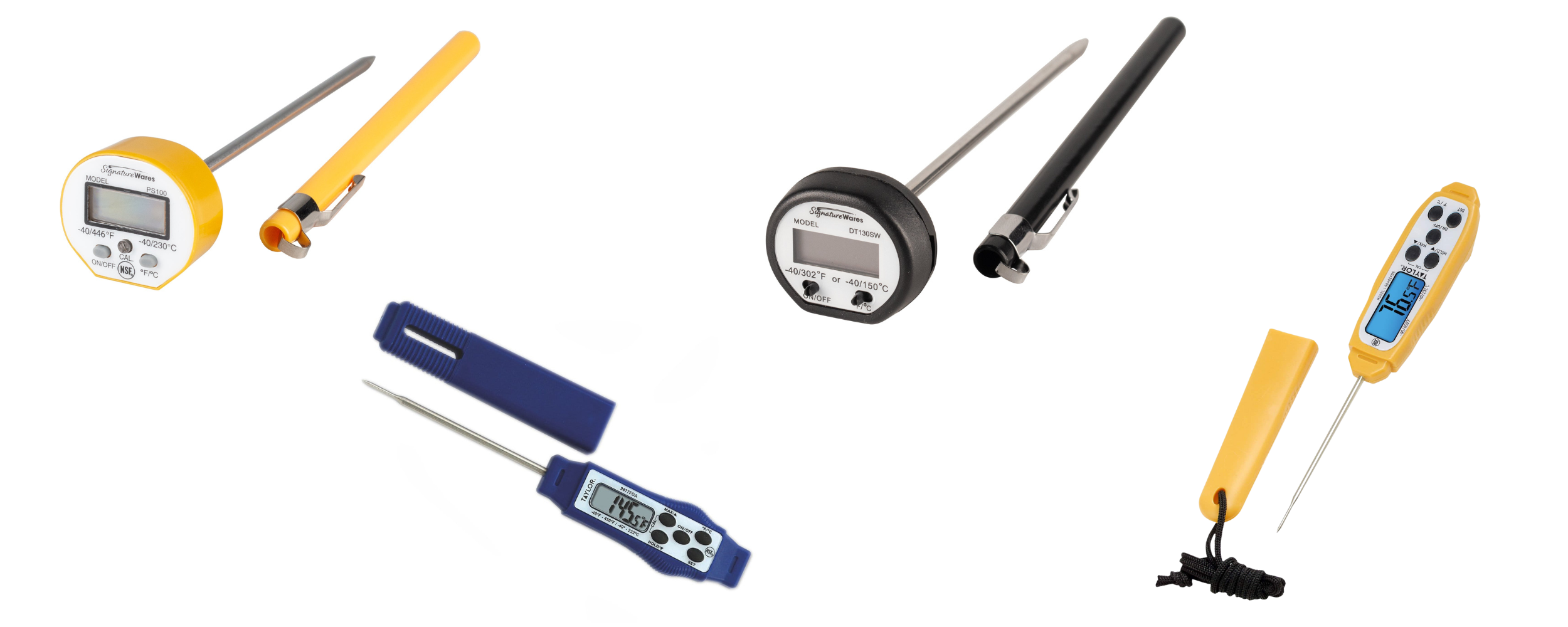
Digital Thermocouple Thermometers
Thermocouple thermometers are a favourite in fast-paced operations thanks to quick read times and a wide temperature range. With a probe and digital display, they’re commonly used for internal meat temperatures and receiving checks. They determine temperature by measuring generated electricity.
Popular uses
- Food preparation
- Food holding checks
- Food receiving checks
- Liquids
- Meats
Infrared Thermometers (Pyrometers)
Infrared thermometers measure temperature by detecting heat radiating from a surface—so they can take temperature readings without contact. The distance-to-spot ratio determines how far away you can be while still measuring accurately.
Best for: food holding, receiving checks, extreme temperatures, no-contact needs, and dishwashers.
Popular uses
- Extreme temperatures
- Food holding checks
- Food receiving checks
- No contact
- Dishwashers

Combination Thermometers (Infrared + Thermocouple)
A popular choice is a combination infrared and digital thermocouple thermometer. Staff can monitor internal temperatures and surface temperatures with the same unit—ideal for kitchens that need flexibility without carrying multiple tools.
Popular uses
- Extreme temperatures
- Food holding checks
- Food receiving checks
- No contact
- Dishwashers
- Meats
- Food preparation
- Liquids

Digital Probe Thermometers (Leave-in Monitoring)
Probe thermometers use a probe + cable that can remain in the food while cooking, with the display outside the oven constantly monitoring temperature. They’re great for roasts and large cuts and reduce how often you need to open the oven or lift a grill hood.
Popular uses
- Meat preparation
- Ovens
- Grills
- Catering

Thermometer Features, Functions and Accessories
Once you’ve determined which thermometer types you need, these features can help you choose the right model for speed, accuracy, and durability.
Temperature range
The range must match your task, and it’s best to operate in the mid-range most of the time. Dial thermometers can have limited ranges—choose carefully.
Stems and probes
Stem/probe length and thickness matter. Thin foods (seafood, thin cuts) are best measured with thin-tip thermometers. Some tasks require longer stems (e.g., reaching mid-depth of a frothing pitcher). Pocket thermometers typically benefit from shorter stems.
Field calibration
Field calibration means you can recalibrate for accuracy. Dial thermometers may have an adjustment nut on the back (not all are adjustable). Digitals often have a CAL button. Recalibrate regularly, especially after drops/bumps or long storage.
Response time
How fast the thermometer reaches the final temperature. Don’t pay for speed you don’t need—fridge/freezer thermometers don’t require instant response.
Displays
Display size matters—especially if you need to read temps from a distance. Some dial/liquid thermometers include colour-coded zones; some dial models glow in the dark for oven visibility. Digital models may include large digits, backlights, and audio indicators.
Accuracy (increments)
Accuracy refers to increments the thermometer can measure. Dial thermometers often read in 2° increments (sometimes higher). Digital can be as low as 0.5° and up to 2°.
Clips
Pocket clips help with carry; pot clips allow constant monitoring in deep frying or candy making.

Sleeves / sheaths
Protect stems/probes from damage. Some dial thermometer sheaths can assist with recalibration. Some sleeves include key temperature references. Folding probes can eliminate the need for sleeves.
Mounting and storage
Consider how the thermometer is mounted or stored: standing, hanging, magnetic, adhesive, lanyard, pocket clip—choose based on where it will live in your workflow.

Holding (Hold) function
Locks a measured temperature on screen so staff can record it during busy service.
Min/Max
Tracks the minimum and maximum detected temperatures—useful for HACCP checks and monitoring fluctuations.
Waterproof
Waterproof doesn’t mean “submerge forever.” It means the thermometer can handle splashes, steam, and quick dunks. Always confirm water tolerance in specs.
Ovenproof
Ovenproof means the entire unit (casing and lens) can withstand oven temperatures. Many thermometers can read high temps but can’t be left inside—check manufacturer limits.
Auto shut-off
For digital models, extends battery life by turning off after inactivity. Some models don’t recall the last measurement—record temps right away.
Timers
Often included with probe styles and helpful in busy kitchens.
Programmable presets
Allows preset temperatures/times for common menu items and production tasks.
Probe wipes
Fast, easy sanitizing—especially helpful when testing multiple foods in quick succession.
Quick Picker (Choose the Right Thermometer)
Reminder: Infrared = surface only. For internal temps, always use a probe/stem thermometer.
FAQs
- Do I need more than one thermometer type?
- Usually, yes. Most kitchens use a mix: a digital instant-read for internal temps, a fridge/freezer thermometer for monitoring, and optionally an infrared or probe thermometer for surface checks and leave-in cooking.
- Can infrared thermometers measure internal food temperature?
- No. Infrared thermometers read surface temperature only. Use a probe/stem thermometer for internal temperatures.
- When should I choose a probe thermometer?
- When you need leave-in monitoring in ovens or grills (roasts, large cuts) so you can track temperature without repeatedly opening equipment.
- How often should thermometers be calibrated?
- Calibrate regularly, and always after drops/bumps or long storage. Follow manufacturer instructions for your specific model.
- What does “waterproof” really mean?
- It usually means splash/steam resistant and capable of surviving quick accidental immersion—limits vary. Check the product specifications for water tolerance.
- What’s the most important feature to prioritize?
- Match the thermometer to the job: internal vs surface, speed needs, temperature range, and durability for your environment. After that, prioritize readability and ease of cleaning.
Shop Cooking and Kitchen Thermometers
No matter what type of kitchen you operate, thermometers are essential to maintain consistency, quality, and safety.
© Russell Hendrix — Commercial Kitchen Thermometers Buying Guide
