
Commercial Frying Pan Buying Guide
An Essential Guide to Choosing Commercial Frying Pans for Your Kitchen
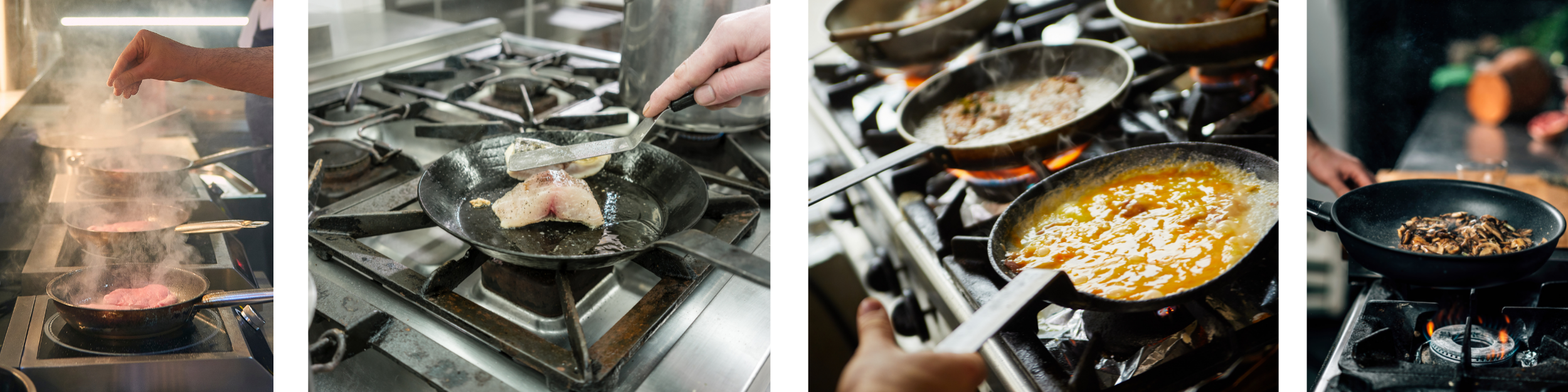
Commercial fry pans do a lot of work in a busy kitchen. They sear proteins, fry eggs, sauté vegetables, reduce sauces, finish pasta, braise, poach, and handle countless line tasks throughout service. In a professional setting, a fry pan needs to heat predictably, feel balanced in the hand, clean up efficiently, and stand up to repeated daily use.
The basic shape of a fry pan has not changed much, but materials, finishes, handles, and construction have. Today, there is a commercial fry pan for nearly every menu, station, and budget. This guide breaks down the main material, finish, and construction choices so you can choose the right pan for the way your kitchen actually cooks.
Why Use This Fry Pan Buying Guide
Not every commercial fry pan is built for the same kitchen need. Some are better for fast-moving line work. Others are better for delicate foods, high-heat searing, induction cooking, or longer-term durability under repeated use.
This guide is designed to help you compare the main material and finish options, understand where each one fits best, and narrow the right pan for your menu, cooktop, and pace of service.
Common Kitchen Needs
Commercial fry pans are often chosen around the kind of cooking your kitchen does most often.
Start with How the Pan Will Be Used
Before comparing materials, think about what the pan needs to do. A breakfast line cooking eggs and pancakes has very different needs than a steakhouse searing proteins or a café finishing vegetables and pasta throughout the day.
Some kitchens need lightweight pans that cooks can move quickly during service. Others need heavier pans that retain heat and stand up to harder use. Some need a natural cooking surface for browning and searing, while others need nonstick performance for delicate items.
Start with these questions
- What foods are you cooking most often?
- How important are speed, weight, and ease of handling?
- Do you need natural finish, nonstick, or both?
- Are you cooking on gas, electric, or induction?
Why one pan usually is not enough
In many commercial kitchens, the best answer is not one pan for every task. It is usually a mix. Aluminum or clad stainless may cover general line work, nonstick may handle eggs and delicate items, and carbon steel or cast iron may support high-heat searing.
Frying Pan Materials
Each material comes with strengths and trade-offs. The main things to compare are heat conductivity, weight, durability, reactivity, maintenance, and price. Pan thickness, often called gauge, matters too. In general, the lower the gauge number, the thicker the pan.
There are also two main surface types: natural and nonstick. A natural finish means the cooking surface is the material itself. A nonstick finish adds one or more coatings to the food-contact surface.
Induction note
- Aluminum is generally not induction-ready.
- Carbon steel and cast iron usually are.
- Stainless steel and clad pans may or may not be, depending on construction.
- Always confirm compatibility before buying.

Aluminum Frying Pans
Lightweight, budget-friendly, and quick to respond to temperature changes. A practical starting point for many kitchens, especially where cooks are handling pans all shift.
Heavy-Duty Aluminum
Better suited to harsher kitchen conditions where a lighter pan may warp too easily. More weight, but also more durability.
Stainless and Clad Construction
Strong for durability, presentation, and broader versatility. Clad pans help solve stainless steel’s slower heat response by adding an aluminum core or layer.
Compare Fry Pan Materials
Browse the full Russell Hendrix fry pan assortment to compare aluminum, clad, stainless, carbon steel, cast iron, and nonstick options.
Aluminum fry pans
Aluminum fry pans remain one of the most common choices in foodservice because they are lightweight, budget-friendly, and quick to respond to changes in temperature. That lighter weight matters during a long shift, especially on a busy sauté or breakfast station.
The main trade-offs are durability and reactivity. Aluminum can react with acidic foods, and lighter pans may warp under prolonged high heat or rough treatment. Heavier-gauge aluminum pans are better suited to demanding commercial environments.
For value-focused kitchens, SignatureWares is one practical option within the Russell Hendrix fry pan assortment.

Anodized aluminum fry pans
Hard-anodized aluminum improves on standard aluminum by adding a harder, less reactive surface. It is more resistant to wear and better suited to foods that would be problematic in plain aluminum. Many anodized fry pans also include a nonstick interior, which makes them useful in kitchens that want easier release and cleanup while keeping pan weight manageable.
Stainless steel and stainless-clad aluminum fry pans
Stainless steel fry pans are durable, non-reactive, and easy to clean. They are a strong fit for sautéing, browning, deglazing, and any application where you want a pan that can take abuse and still look presentable on the pass or buffet.
Clad fry pans combine the strengths of multiple materials. Most often, stainless steel is layered with aluminum to improve heat distribution while keeping the cooking surface durable and non-reactive.
For operators looking for stronger heat performance, broader commercial durability, and options that may suit induction depending on the model, Vollrath is one of the useful brands to consider within the Russell Hendrix fry pan assortment.

Carbon steel fry pans
Carbon steel has become a favourite in many professional kitchens because it brings together strong high-heat performance and a lighter weight than cast iron. It heats quickly, retains heat well, and develops a naturally slick cooking surface as it seasons over time.
The trade-off is maintenance. Carbon steel needs seasoning, can rust if neglected, and can react with acidic foods. For kitchens that do not mind that extra care, it is one of the hardest-working options available.

Cast iron frying pans and skillets
Cast iron is valued for its heat retention, durability, and long service life. Once seasoned properly, it develops a natural release surface and performs especially well for searing, oven finishing, and applications where steady retained heat matters.
The downside is weight. Cast iron can be tiring to handle during a long shift, and it requires more maintenance than aluminum or stainless steel. It is not the pan most cooks want to swing around all service, but it remains a useful specialty pan for high-heat work.
For kitchens that want deep searing performance and a pan that can last for years, Lodge is one of the most recognizable cast iron brands in the Russell Hendrix fry pan assortment.

Nonstick Frying Pans
Nonstick fry pans shine when the food is delicate and release matters. Eggs, omelettes, pancakes, crepes, and fish are the classic examples. They reduce the need for added oil and make cleanup faster.
In commercial kitchens, nonstick pans are usually best treated as task-specific tools rather than as all-purpose workhorses. They perform very well, but they do not usually last as long under hard line use as natural-finish pans do.
Best used for
- Eggs and omelettes
- Pancakes and crepes
- Fish and delicate proteins
- Low-oil cooking applications
Easy Food Release
Nonstick makes delicate foods easier to cook cleanly and consistently, especially where presentation matters.
Lower-Oil Cooking
These pans are useful where you want to reduce added oil while keeping cooking and cleanup simple.
Best as a Task-Specific Pan
In commercial kitchens, nonstick usually performs best when reserved for the foods that actually benefit from it.
Shop Nonstick Fry Pans
Browse the Russell Hendrix fry pan collection to compare nonstick options across materials, sizes, and commercial cookware lines.

What to watch with nonstick pans
Modern coatings are stronger than older versions, but they still need care. Avoid overheating, metal utensils, and abrasive scrubbers. They are most valuable when used for the foods that actually benefit from nonstick performance.
Frying Pan Handles
A fry pan body gets most of the attention, but the handle affects comfort, control, and safety just as much. In a busy kitchen, the wrong handle can slow a cook down or make a pan harder to manage during service.
Look for
- Comfortable leverage
- Secure attachment
- Practical heat management
- Helper handles on larger pans

Handle length and width
Most fry pan handles are proportioned to give enough leverage without taking up too much room on the range. If a handle is too long, it gets in the way. If it is too short, the pan feels less secure to lift and move. Cast iron is the main exception, since its handles are usually shorter because of how the pans are made.
Helper handles
Larger or heavier pans may include a helper handle opposite the main handle. That second grip makes two-handed lifting much safer and more comfortable, especially on big aluminum, clad, or cast iron pans.

Handle material
Hollow stainless steel handles tend to stay cooler than solid metal handles. Silicone sleeves can also improve comfort, though operators should always confirm whether the sleeve is oven-safe or removable. Carbon steel and cast iron handles can get very hot and stay hot, so they demand more caution on the line.
Handle attachment
Most commercial fry pans use riveted handles. Rivets are durable, but they can make cleaning around the attachment points more difficult. Some pans are designed with rivetless interiors for easier cleanup, while others use welded handles to create a smoother interior surface.

Fry Pan Shapes and Styles
Most frying pans share the same basic structure: flat bottom, low sides, and a shape that makes it easy to turn, toss, and move food. That said, small differences in sidewall shape can change how the pan behaves.
Classic fry pans have sloped sides that make tossing and flipping easier. French fry pans usually have taller, straighter sides, which increases capacity and makes them feel a bit closer to sauté pans. A straight-sided pan, however, is really a sauté pan rather than a fry pan.
Quick rule of thumb
- Classic fry pan for fast movement and flipping
- French fry pan for more volume
- Sauté pan for straighter sides and liquid control
Which shape fits best?
If your cooks need fast movement and flipping, a classic fry pan shape usually makes the most sense. If you want a little more volume and control, a French fry pan or sauté pan may be the better choice.
How to Choose the Right Commercial Frying Pan
The right fry pan depends on how your kitchen actually cooks. Start with a few practical questions, then narrow the construction and finish that best fits the job.
Ask these before buying
- What foods are you cooking most often?
- Do you need natural finish or nonstick?
- Are you cooking on gas, electric, or induction?
- How important are weight, durability, and maintenance?
- Are you buying for one station or standardizing across multiple stations?
Choose by Menu
Delicate foods, high-heat searing, and general line cooking all place different demands on the pan.
Choose by Cooktop
Induction compatibility in particular can narrow the right options quickly.
Choose by Workflow
Weight, handle feel, cleanup, and durability all affect how the pan performs over a full shift.
Compare Commercial Fry Pans
Browse the full collection to compare construction, finish, size, and brand in one place.
Shop Commercial Frying Pans at Russell Hendrix
Russell Hendrix carries commercial fry pans for a wide range of kitchen needs, including aluminum, heavier-duty aluminum, stainless, clad, carbon steel, cast iron, and nonstick formats. The full fry pan collection is the best place to compare construction, size, and application in one place.

